Shih Tzu coats do not mat because you skipped a brushing day. They mat because the brush never reached the skin. I spent the better part of two years dragging a pin brush over the top of Mochi's coat, feeling smug about it, while a layer of felt quietly built up underneath. The top of a Shih Tzu coat always looks fine. That is the trap. The mat forms at the base, close to the skin, where you cannot see it until it is already tight.
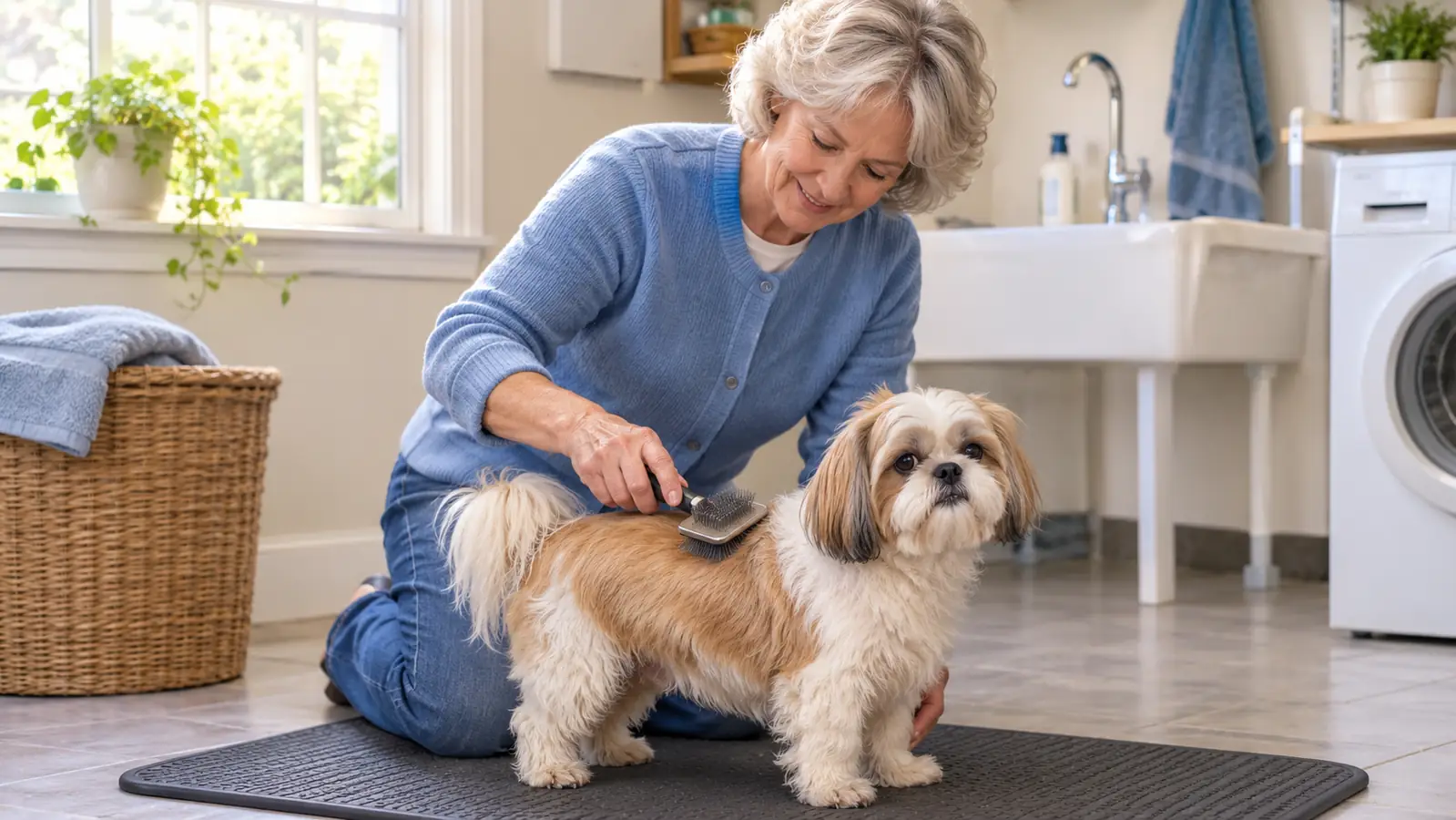
Mochi is seven, thirteen pounds, gold and white, and she lives in a medium puppy cut with a longer topknot. She mats behind her ears no matter what I do, and her front armpits are worse. What finally changed things in this house was a Chris Christensen Big G slicker brush, a rubber mat, and a routine short enough that I keep it up. Twelve minutes, twice a week, on the floor of my laundry room, with the utility sink behind me and a lick mat in front of her.
Here is what the pet store will not tell you. A pin brush is for fluffing a coat that is already combed out. It skates over a mat and leaves it exactly where it found it. A metal comb tells you the truth but does not do the work. The slicker does the separating, which is why the Chris Christensen Big G has stainless steel pins, a wooden handle, and a curved back that lets the head sit flat against a real body instead of hovering above it.
The brush that reaches skin on the first pass
The Big G carries 30 percent more pins than a standard slicker, so each stroke covers more coat and you take fewer of them. Non-slip grip, curved wooden handle, stainless steel pins. It is the tool I reach for before anything else in the basket.
Amazon Check Today's Price on Amazon →Step 1: Build a station where the coat stays dry and the dog stays put
Work dry. A wet Shih Tzu coat stretches, and a brush pulled through wet hair snaps it. If Mochi has just had a bath, I towel her off, run the blow dryer on the cool setting until she is fully dry, and let her settle for ten minutes. Brushing a damp coat is how you end up with a frizzy, broken finish that looks like a bad perm by Thursday.
A rubber mat on the floor or the dryer does more for cooperation than any treat I have tried. When the feet slide, the dog braces, and a braced dog turns a small tangle into a wrestling match. I put the mat down, set Mochi on it facing away from me so she cannot watch what I am doing, and keep one hand flat on her shoulder the whole time.
Then I section. I part her coat down the spine, clip the top half forward out of the way, and work in panels about as wide as the brush head. On a thirteen pound Shih Tzu that is seven panels, give or take. Counting them out loud keeps me calm, and a calm handler brushes better. Rushing is what makes a dog hate the table.
The first month I did this, I used bobby pins from the bathroom drawer to hold the sections. They slid out every time she shook, and I spent more time chasing pins across the floor than brushing. Plastic jaw clips that open wide enough to hold a finger's worth of coat fixed that in one trip to the drugstore, and six of them now live in a little dish beside the mat. I clip the top half forward, brush the bottom half, then let the top half down and do it again, which means every panel gets brushed twice and nothing gets skipped.
Step 2: Line brush, which means rows instead of one long stroke down the back
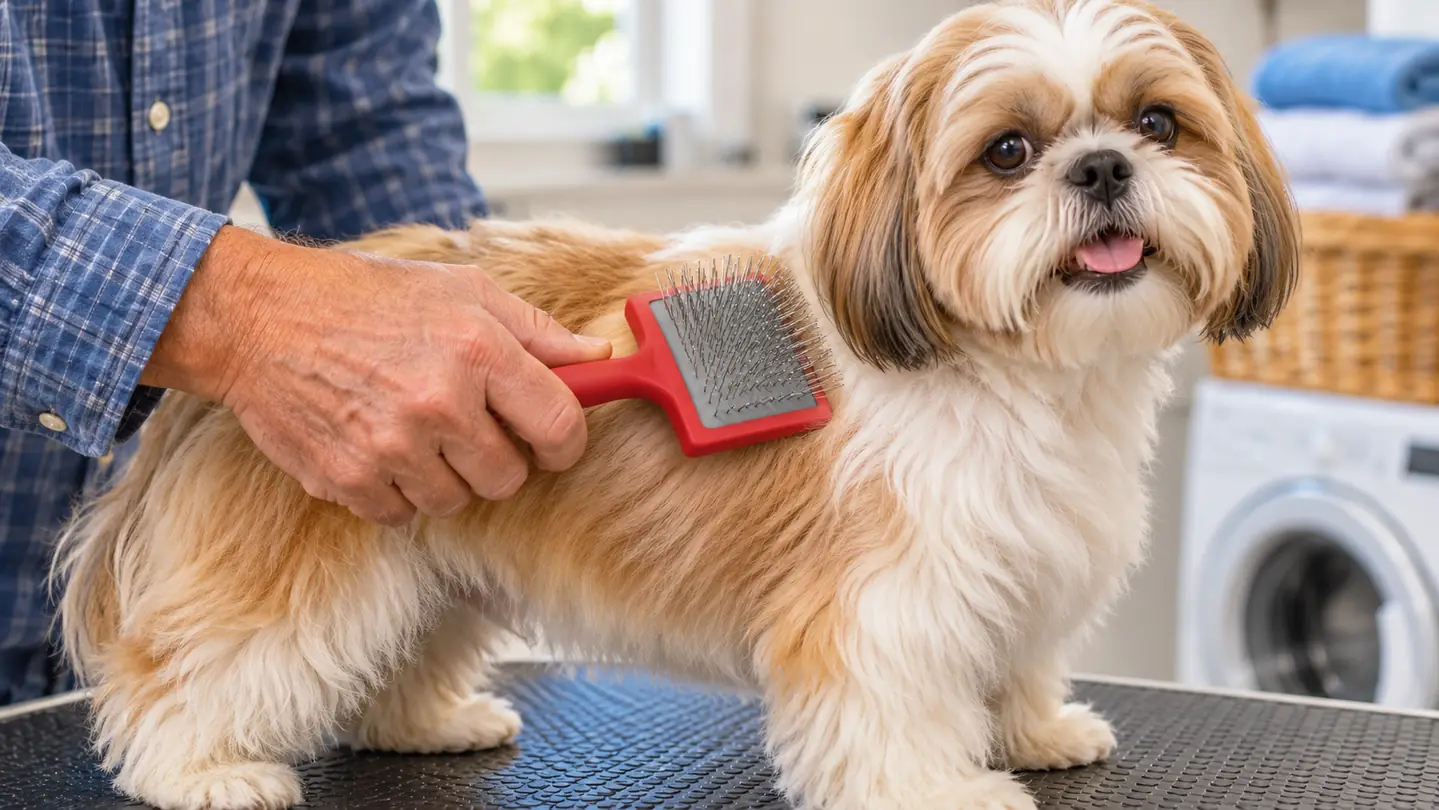
Line brushing is the whole technique and it takes one sentence to explain. Push a thin line of coat forward with the back of your hand, brush that line from the skin outward, then move over an inch and do it again. You are not brushing the dog. You are brushing a series of lines, one after another, from the head to the tail and down each leg.
This is where a wide head earns its keep. The Chris Christensen Big G measures 8 by 4 by 2.5 inches, so one pass covers a genuine line instead of a narrow pin track, and the pins that are not sitting on a tangle are still smoothing the coat around it. Thirty percent more pins sounds like a catalog line until you feel how much less back and forth you do. My wrist notices.
Pressure is the other half of it. You are not scrubbing a floor. Let the pins find the coat and let the weight of the head do the work. If you can hear scraping, you are pressing too hard and you are teaching the dog to leave. Light strokes, many of them, finish faster than three hard ones.
The pins should touch skin. Twelve minutes of that, twice a week, on a thirteen pound dog, and the clippers stayed in the drawer.
Step 3: Clear the trouble zones before you do anything that looks nice
Behind the ears is where a Shih Tzu coat betrays you. The hair there is fine and it rubs against itself every time she shakes her head, so it felts from the inside out. I fold the ear flap back, pinch the hair between two fingers so I am not pulling skin, and brush that patch in short strokes away from the head, working from the outer edge of the mat inward.
The armpits are next, and they are worse because you cannot see them. I lay Mochi on her side, lift the front leg forward and up, and work only the corner of the brush head into the hollow. If the mat is tight against the skin, I do not yank. I loosen the edges for a minute, set her down, and come back later. A mat that has been opened at the edges usually gives up on the second visit.
Last February I found one behind her right ear on a Saturday morning that had gone tight enough to pull the skin when I lifted the flap. I worked the outer edge for three minutes, gave her a break on the kitchen floor, and came back to it that evening and again on Sunday. Three short sittings opened it. One long one would have ended with both of us upset and the mat still there. A mat is a project, not a single stroke.
One hard rule in this house: no scissors near a mat. Shih Tzu skin is thin, it sits loose on the body, and it tents up into the blade before you know it is there. I have done it once and I am not doing it again. If a mat will not come out with the brush, it gets clipped by a groomer or it gets shaved, and neither one is a tragedy.
Step 4: Feet, face, and topknot, in that order, because the order matters
Mochi has never liked anyone near her feet, and I doubt yours is different. What works here is one foot at a time with something to lick. I smear a little peanut butter on a lick mat, wait until she is committed to it, and brush from the toes up toward the wrist so the hair lays down the way it grows. Toes first while she is distracted, then the back feet, then a break.
The first time I tried it, I held her foot up in the air with one hand and brushed with the other, and she pulled it loose twice before I got a single stroke in. Now I keep the foot down on the mat and brush with the flat of the head instead of lifting anything. She holds still for the front two, and I take the back two in a second sitting ten minutes later. Two short sessions beat one long one every time, and the peanut butter does the rest.
The face I do not touch with the slicker at all. The pins are stainless steel and the skin around the eyes and muzzle is thinner than anything else on the dog. I use a small metal comb on the muzzle, and I use my fingers to lift the hair out of her eyes. Whatever is left goes up into the topknot.
The topknot gets brushed up and back before the band goes in, never straight down. Brushing it up trains the hair to stand, which is why hers stays put until Thursday instead of flopping into her eyes by Tuesday afternoon. The little bit of coat that grows between the eyes gets trimmed with blunt-tip scissors, by someone else, at the groomer.
Step 5: Run a comb through it, then set a schedule you will actually keep
When you think you are finished, run a metal comb through the coat, all the way to the skin. If the comb stops, there is still a mat there and the slicker has not finished its job. Go back to that spot with the brush rather than the comb. Combs find problems. Brushes solve them, and a comb dragged through a tight mat hurts enough to end the session for the day.
The schedule that has actually held in this house is twice a week for the body, every other day for behind the ears and the topknot, and a full brush out the day before a bath. A mat that goes into the tub comes out tighter, so the day before matters more than the day after. I keep the Chris Christensen Big G on the counter by the utility sink where I will see it, not in a drawer.
That is the entire system. No clippers, no shave-down, no long appointment that ends with a dog who hides when the carrier comes out. A shave-down undoes eight months of coat and it undoes the dog's trust in the table too. Twelve minutes twice a week, and that is the whole of it.
What Else Helps
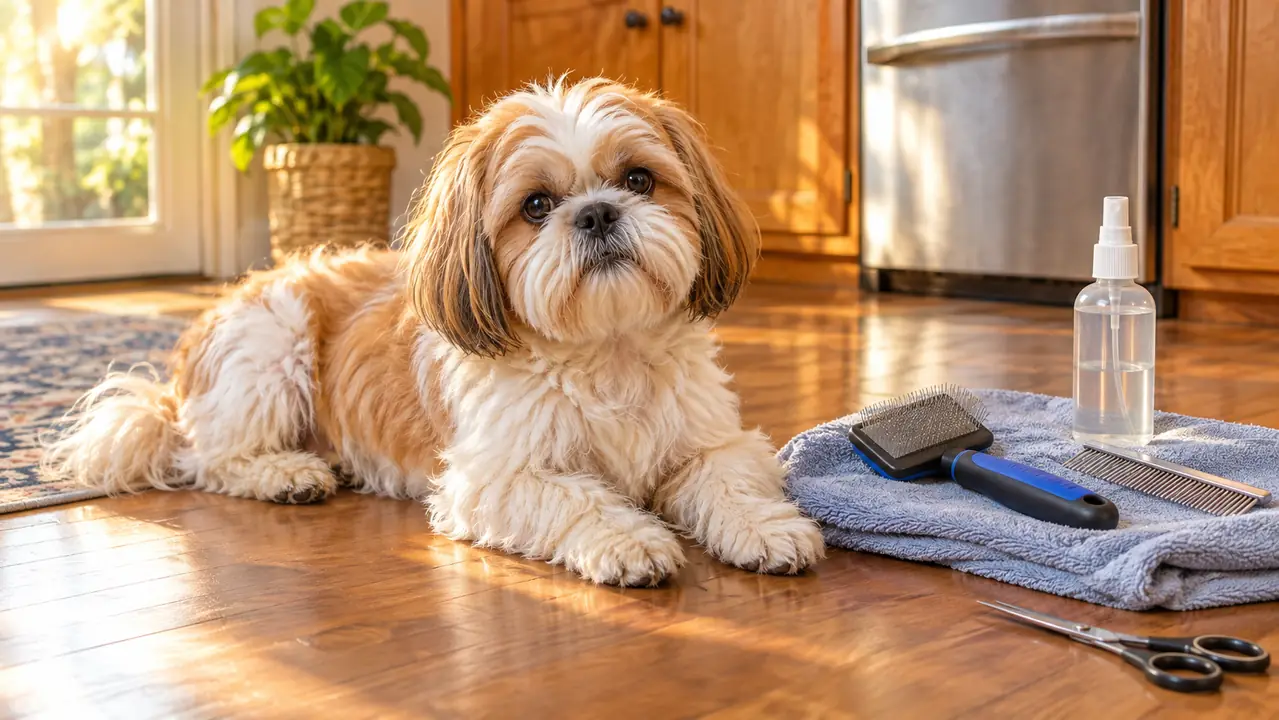
The Big G is the tool that does the work, but three other things earn their place in the basket. A metal comb for the final check, because it will tell you the truth about a coat that looks smooth. A light detangling spray used on the section you are working, not on the whole dog, because too much product makes a Shih Tzu coat tacky and dirt sticks to it. And a rubber mat, which I have already mentioned twice and will mention again.
Two more worth knowing. The brush comes in three sizes, and the large is what fits a thirteen pound body without making me work in tiny strips. And a cool blow dryer before any brushing saves a step, because a coat that is 90 percent dry still mats at the root. Between baths, a quick five minute pass behind the ears on a Tuesday keeps a small tangle from turning into a Saturday problem.
I bought a second, smaller brush for the topknot early on and I barely use it. One tool that fits your hand beats a drawer full of them, and a wide head lays flat on a moving dog more easily than a narrow one does. If you are going to buy one grooming tool this year, buy the slicker and skip the rest until you know you need them. The comb came second in this house, about a month later, and only because I wanted proof that the brush had done its job.
Twelve minutes, twice a week, and the clippers stay in the drawer
The Chris Christensen Big G is the brush that made home grooming workable here. Stainless steel pins, a curved wooden handle, a non-slip grip, and 30 percent more pins per pass than a standard slicker. Start behind the ears and see how it goes.
Amazon Check Today's Price on Amazon →