The first slicker I ever bought for Mochi came off a peg at the grocery store and was the cheapest one on the shelf. The pins bent the first week. The mats behind her ears did not move a fraction of an inch. I spent four years convinced I was bad at brushing a dog, when the truth was simpler and a little insulting: a soft slicker does not detangle a Shih Tzu coat, it just rearranges the top layer so everyone feels productive. The mats sit down near the skin, and you need a brush stiff enough to reach them. That is how the Chris Christensen Big G Dog Slicker Brush ended up on my laundry room counter, in the Large size, about two years ago.
I am going to be straight with you, because the reviews that are not straight with me are the ones I resent. This brush is built and sold for Goldendoodles, Labradoodles and Poodles. It is a professional groomer's tool aimed at thick, curly, high density coats, and Mochi is thirteen pounds of gold and white Shih Tzu in a medium puppy cut. She is not who it was designed for. So this is a review of what happens when a retired school nurse in Fort Worth uses a doodle brush on a lap dog for two years: what it does better than anything else in my cupboard, what it does badly, and the one thing you should never do with it.
The Quick Verdict
Stiff enough to actually break up the mats behind Mochi's ears without shaving her, but it is more brush than a small Shih Tzu needs, and the steel pins will teach you to lighten your hand whether you want to learn or not.
Amazon Check Today's Price →The brush that finally reached the mats behind her ears
Two years of near daily use on a thirteen pound Shih Tzu, and the groomer has not gone near the clippers behind Mochi's ears since. Read the measurements before you pick a size, because the Large is a lot of brush for a dog this small.
Amazon Check Today's Price on Amazon →What Nobody Tells You About Using a Doodle Brush on a Shih Tzu
The first thing is that the pin count is the whole reason it works. The Chris Christensen listing says the Big G carries 30% more pins than a standard slicker, and holding it next to my old one, I believe it. It is a dense field of stainless steel pins set into a wooden head, and on a thick curly coat that density separates the hair into thin sheets instead of dragging across the top of it. On Mochi's coat, which is finer and lighter than a doodle's, that density means one stroke covers most of her ribcage. Fewer strokes, less fidgeting, and a dog who is still willing to stand there for the next two minutes.
The second thing nobody mentions is that this brush talks to you. When Mochi's coat is clean and combed out, the pins glide and I can brush with almost no pressure at all. When there is a mat, the brush stops dead in my hand. I used to think that was a flaw. Now it is how I find mats in the first place, a full week before I would have spotted one with my fingers. A soft brush slides right over a mat and hides it from you. This one refuses to.
The third thing is that it is a plain brush. Wood handle, steel pins, nothing to adjust, no button to push. After two years I have decided that is a feature and not a shortcoming. There is nothing on it to break, and nothing on it to distract me from the actual work, which is paying attention to where the pins are on my dog. The tradeoff is that cleaning it is manual. After every session I pull the hair out of the pin field by hand and run a metal comb through it.
The listing also calls it a deshedding brush that removes trapped undercoat with fewer strokes. I was skeptical of that word, because every brush claims it. What I can tell you is that after a winter of using it, the amount of loose hair I pick up off the table at the end of a session is noticeably smaller than it was with my old slicker, and I am brushing for less time overall. Whether that is the pin density doing the work or the fact that I brush more often because it works, I honestly could not tell you. Fewer strokes is the claim. Fewer strokes is what I got.
How I Actually Use It on Mochi
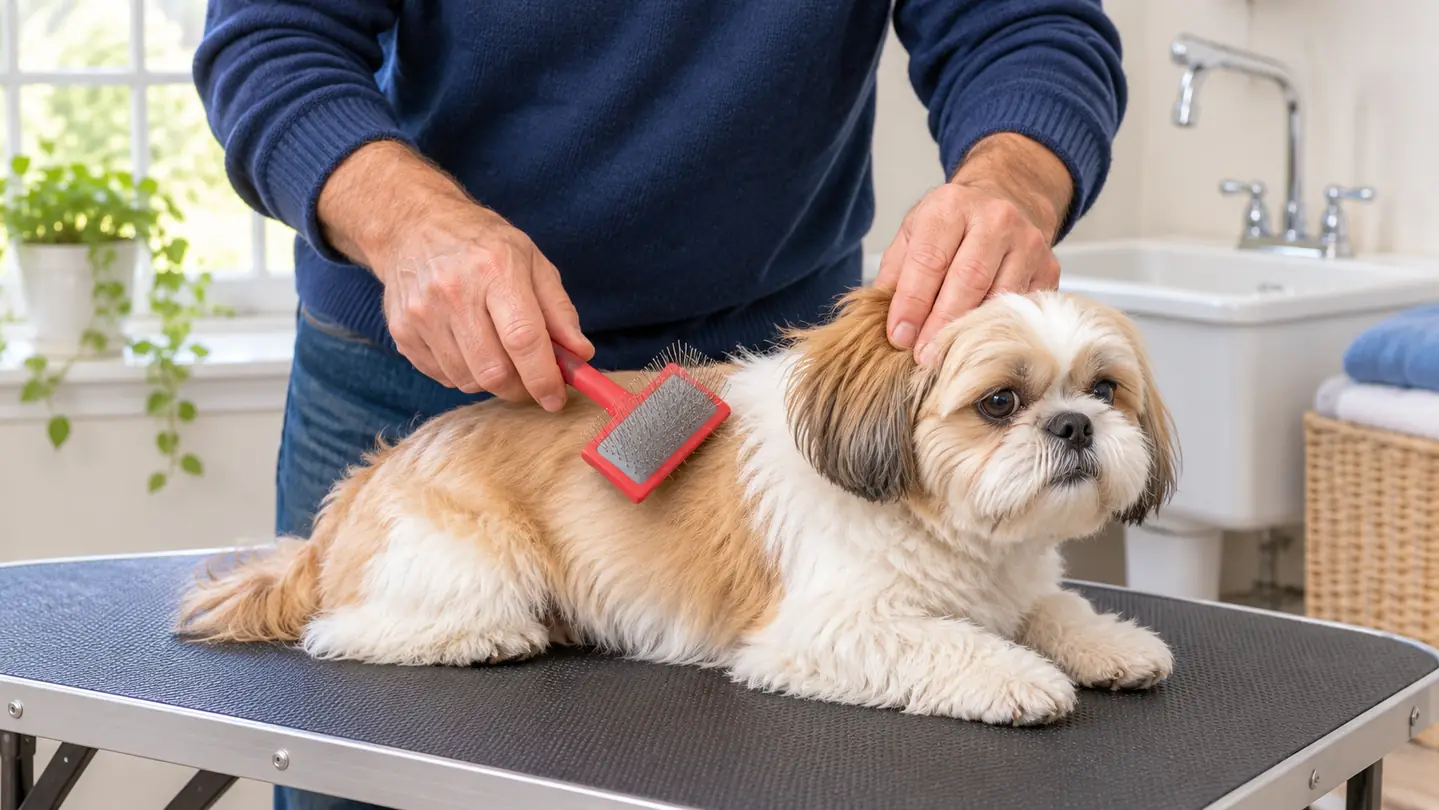
Bath day happens in the utility sink in the laundry room, because Mochi is thirteen pounds and the kitchen sink hurts my back. I towel her down until she is damp rather than dripping, then brush her while the coat is still slightly wet. That is when the Chris Christensen brush earns its keep. The pins move through damp coat with far less drag than a pin brush, and the mats behind her ears soften enough to work loose in layers instead of coming out in one piece with a yelp.
The technique that finally worked for me is line brushing, which sounds fancy and is not. I part the coat with the fingers of my left hand, hold the hair up out of the way, and brush the strip of skin I just exposed, working from the skin outward. Then I move over an inch and do it again. On a dog this small, the whole body takes about six minutes if there are no mats and about fifteen if there are. I do the ears and the armpits first, while we are both still patient, and the feet last, one foot per session, because Mochi has strong opinions about her feet.
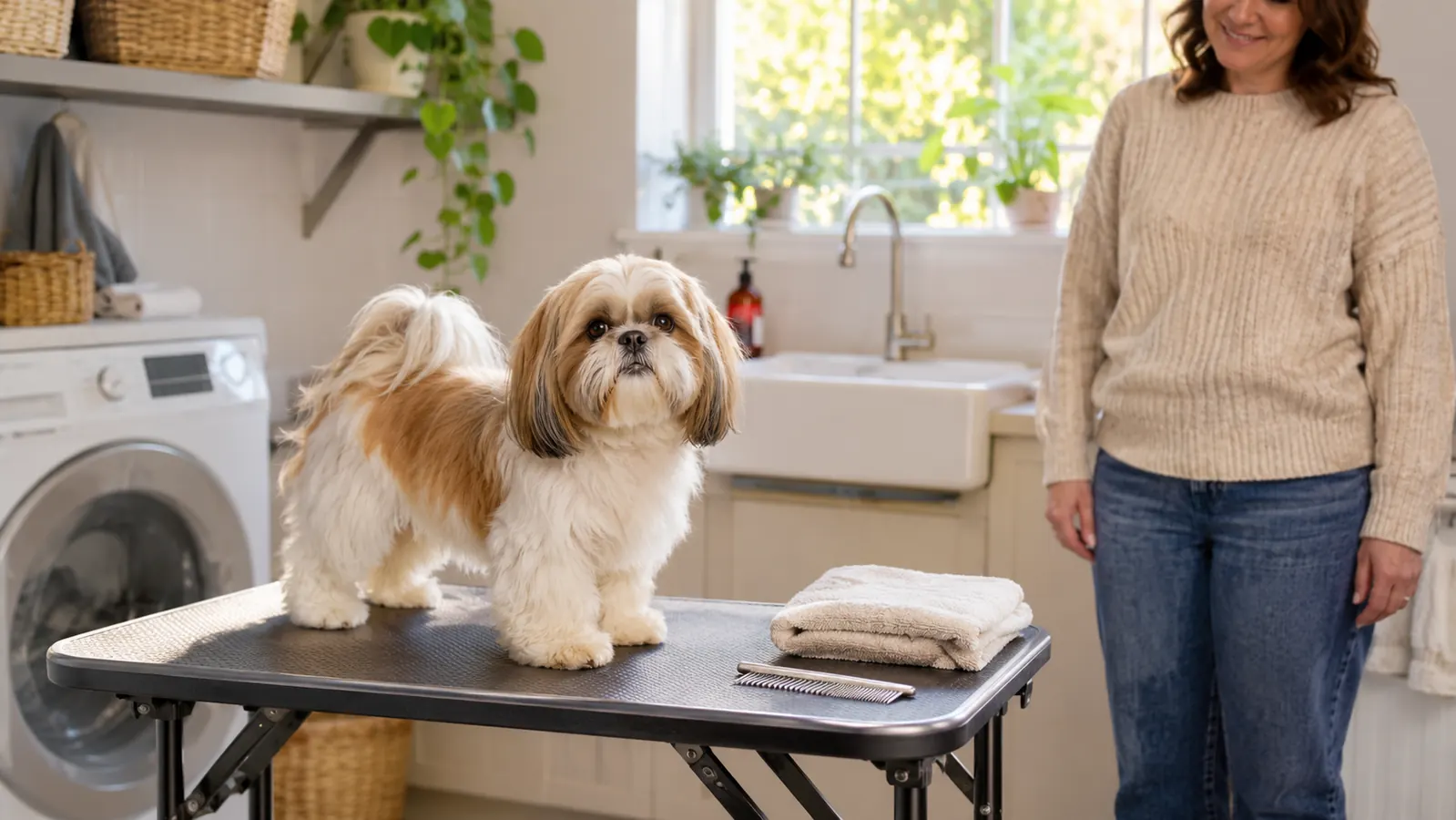
The other thing I changed is where we do it. I used to brush her on the floor and wonder why my shoulder ached. Now she stands on the folding table I keep in the laundry room and I stand at chest height to her, with the curved back of the handle resting in my palm. That curved back is not decoration. It sits in the hand and lets me control the head with my wrist instead of my whole arm, which matters when you are sixty-two and your right thumb has opinions of its own.
I brush her four or five days a week, which sounds like a lot and is not. Four minutes on a Tuesday prevents a forty minute fight on Sunday, and it prevents the thing that actually costs you, which is a mat that goes too far to fix at home. If you take one habit away from this review, make it the four minutes. The brush is the tool, but the schedule is the part that changes the outcome.
The Mats Behind the Ears Are the Real Test
For four years, the mats behind Mochi's ears were a clipper job. I would find them, pick at them, make them worse, and hand her to the groomer, who would shave the ear leathers down and tell me kindly that Shih Tzus mat there. She was right, and it still made me feel like I had failed a test. The first time I used the Big G behind the ears, I held the ear leather flat in my palm, brushed with short strokes and kept the pin tips angled away from the skin, and the mat came apart in about four minutes.
It did not happen overnight and it did not happen in one session. It took about six weeks of two minute sessions, most days, before the coat behind her ears stopped felting between grooms. The brush was half of that. The other half was not letting it go three weeks, which is exactly what I had been doing for years without admitting it to myself. The tool helps. The schedule is what actually fixes it.
The armpits are harder, because no dog wants a hand in there. I lift the front leg and brush the flat, thin skinned area under it with the lightest pressure I can manage, and I stop the second she tenses. Here is the honest limit: if a mat has already felted tight against the skin, this brush will not fix it and you should not keep trying. Keep working at it and you will hurt your dog. Cut it out with rounded scissors or let the groomer do it. The Big G is for mats you can still get a comb under.
The Handle, the Pins, and the Learning Curve
The handle is wood with a non-slip grip, and it is heavier than the plastic slickers I used before. For the first week I thought that was a drawback. Then I realized I had been squeezing the old one to keep it steady and squeezing this one not at all, and the ache in my thumb went away. The whole brush measures eight by four by two and a half inches, and the head is broad, so on a thirteen pound dog a single stroke covers most of her side. It also means the brush is bigger than the area I am working on in some places, and I use the corner of it around her face.
The pins are stainless steel and they are not forgiving. That is the part of this review I want to be clearest about. On a doodle with a thick coat, the pins never get anywhere near skin. On a Shih Tzu in a puppy cut, with thin skin at the ear leathers, the armpits and the back of the hind legs, you are one careless stroke from a yelp. I learned to brush with the weight of the brush and a loose wrist. The first two weeks I pressed, and Mochi walked away from me twice, which she had never done before. That was my fault, not the brush's.
There is a learning curve, and it is shorter than you would think. Light pressure, short strokes, work in layers, stop when the dog tells you to. Once I figured that out, Mochi started parking herself on the folding table in the evening, which I take as the highest review she is capable of giving. It is also worth saying that this Chris Christensen brush has held up where the cheap ones did not. Two years of near daily use, one wooden handle, no loose pins, no split head. The grocery store slickers I used before lasted about four months each.
What I Liked
- Pins are stiff enough that mats behind the ears actually loosen instead of getting polished over
- Dense pin field covers a lot of coat per stroke, which shortens every session
- Wood handle with a non-slip grip and curved back is easy on older, arthritic hands
- Picks up noticeably less loose undercoat than my old slicker, with fewer strokes
- Still solid after two years of near daily use, where cheaper brushes died in months
Where It Falls Short
- More brush than a thirteen pound Shih Tzu needs, and it is not the cheap option
- Steel pins on thin skin will scratch if you press, and the brush will not protect you from yourself
- No button, nothing retracts, so cleaning the pin field is a hands on job every time
- It will not replace a metal comb and it will not fix a mat that has tightened against the skin
- The Large is sized for a much bigger dog than mine, so read the measurements before you choose
Six weeks of two minute sessions and the mats behind Mochi's ears stopped being a clipper job. The brush was half of that. The other half was not letting it go three weeks.
What It Won't Do
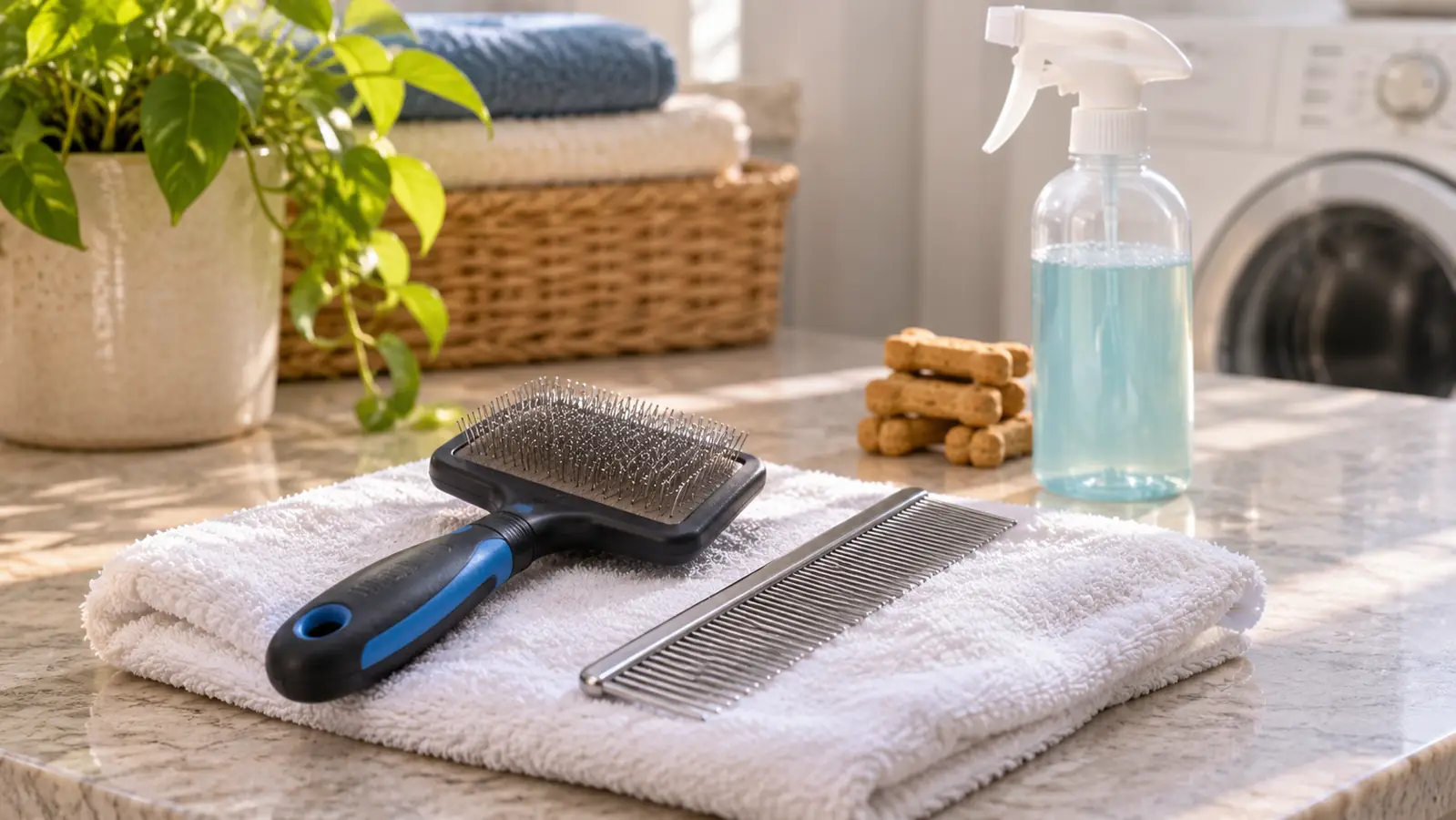
It will not replace a metal comb. I comb first to find the mats and comb again after brushing to confirm they are gone, because the brush can leave a thin tangle behind that feels smooth to your hand and is not. It will not do anything at all for the tear staining under Mochi's eyes, which is a wiping and drying job, not a brushing job. It will not make a Shih Tzu tolerate having her feet handled. And it will not fix a mat that has already tightened against the skin.
Cleaning is on you as well. There is no button and nothing retracts, so hair builds up in the pin field the way lint builds up in a dryer. I clear mine after every session with a comb and it has stayed clean enough. One more thing I learned the hard way: keep the wooden handle out of the sink. I set mine in the soapy water once and the finish dulled. Now it gets wiped with a dry towel and set back on the counter, and it still looks like a tool I take care of.
Who This Is For
This brush is for the Shih Tzu owner who is keeping a longer cut and doing the work at home. If your dog mats behind the ears and under the front legs no matter what you try, and you are tired of those mats turning into clipper jobs, the Chris Christensen Big G is the tool that finally got through them for me. It is also a good fit if your hands are older or arthritic, because the grip and the curved back mean you are not fighting the brush while you work.
And it is worth saying plainly that if your household includes a doodle mix, a poodle or anything with a dense curly coat, this brush is squarely in its lane there. That is what it was built for. The Shih Tzu is the stretch case, and it still works.
Who Should Skip It
Skip it if this is not your situation. If your Shih Tzu wears a short all over clip and sees the groomer every six weeks, you do not have the mats this brush is designed to reach, and a cheaper slicker will do everything you need. Skip it if you want one tool that does the whole job, because you will still need a comb and you will still need to hold the dog still and pay attention.
Skip it too if your dog has very thin skin and flinches at the sight of a brush, or if you know in your heart that you will not use it lightly and often. Stiff steel pins in the hands of someone in a hurry are not a kindness to a dog. And if what you want is a brush that cleans itself with a button, this is not that brush. It is a plain wooden tool with steel pins, and it expects you to show up.
Two years in, it is still the only brush on my counter
If your dog mats behind the ears and you are tired of the clippers, this Chris Christensen brush is the one that got through it for me. Choose your size carefully. The Large is built for a much bigger dog than mine, and a smaller size may suit a thirteen pound Shih Tzu better.
Amazon Check Today's Price on Amazon →