

Mochi has hated having her feet touched since the day I brought her home. She is seven now, thirteen pounds of gold and white Shih Tzu, and she will pull a front paw back like I just asked her to hand over her car keys. For years I let the groomer handle her nails a few times a year, and in between she clicked across the kitchen tile like a tiny tap dancer with somewhere to be.
Then a groomer here in Fort Worth said the thing I did not want to hear. Mochi's nails were long enough to start pushing her toes out of their natural position, and because her coat stays in a medium puppy cut, the hair hides most of the problem until it is a problem. So I bought the Casfuy Dog Nail Grinder and learned to do the job myself. It is a cordless, two-speed grinder with three grinding ports, quiet enough that Mochi stopped flinching at the sound by the second week. What follows is the routine that actually worked, in the order I do it, including the parts I got wrong first.
Fair warning: this is not a five minute job the first time. It is a five minute job the tenth time.
The tool that ended the nail fight at our house
Cordless, two speeds, and three grinding ports sized for small, medium and large nails. Up to 2 hours of runtime after a 3 hour charge, and quiet enough for a nervous dog.
Amazon Check Today's Price on Amazon →The Short Version, If You Are in a Hurry
Touch the paws for a week before you turn anything on. Charge the grinder the night before. Use the small port and the low speed. Take one or two nails per session at first, and quit while she is still relaxed and chewing her treat. Grind a little every two to three weeks instead of a lot every three months. The rest of this is the detail behind those five sentences, because the detail is where most of us go wrong.
Step 1: Teach Her That Feet Are Boring Before You Ever Turn the Grinder On
The grinder is the last thing you introduce, not the first. For about a week before I turned it on for the first time, I sat on the couch with Mochi on my lap during the evening news and touched her feet. One paw, one second, then a treat. Then another paw, one second, treat. That is the whole exercise. No holding, no squeezing, no trying to look at anything, no tool in sight.
By day four she had stopped pulling away, which surprised me more than it probably should have. The trick was that I never made it a production. If she pulled back, I let go and tried again a minute later. A Shih Tzu who learns that a hand near her foot means a piece of chicken is a very different dog from one who learns that a hand near her foot means being held down on a table.
The mistake I made the first time, back before the Casfuy grinder, was going straight to the tool. I had a pair of guillotine clippers from a pet store on Camp Bowie, and I sat down on the laundry room floor with Mochi on my lap and no plan at all. She got one nail done, squirmed loose, and went under the bed. For a solid month afterward she would not follow me into the laundry room, which is also where her food lives, so I knew I had done real damage. If your dog already has that opinion, spend two weeks undoing it before you turn anything on. It feels like wasted time. It is the only thing that saves time.
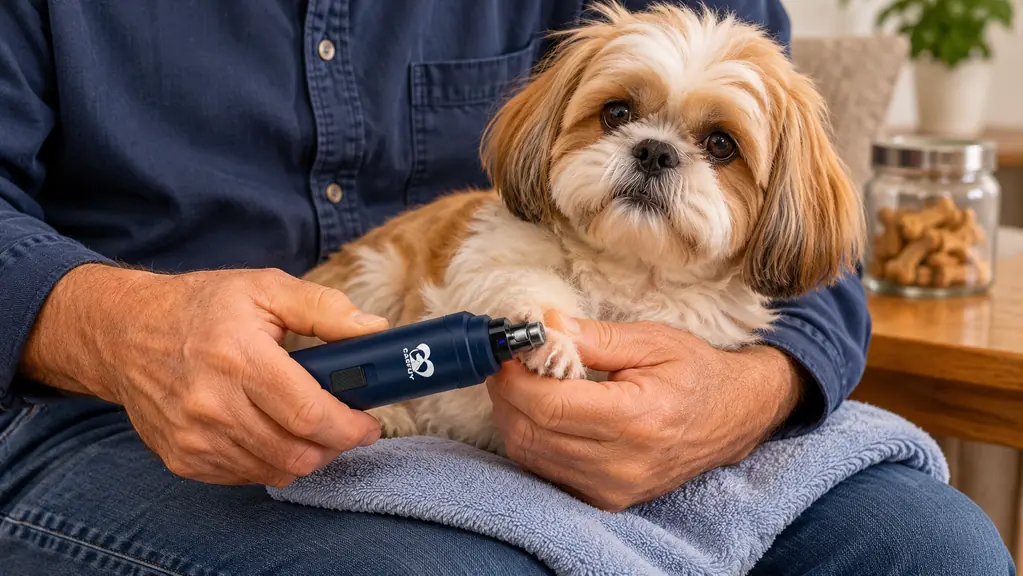
Step 2: Set Up a Station You Can Work One Handed
Everything lives on a folded towel on the laundry room floor: the grinder, a small jar of treats, a paper towel for the dust, and a second towel for her to sit on. I sit on the floor with my back against the washer and Mochi sits between my legs with her back against my chest. That position gives me both hands and gives her nowhere to launch from, which matters more with a thirteen pound dog than it does with a big one.
The grinder is about 9.9 ounces and roughly 6.89 by 2.95 by 1.38 inches, so it sits in one hand without a death grip. The cordless design means there is no cord dragging across the floor for her to notice or chew. The built-in battery gives up to two hours of runtime on a three hour charge, and I charge my Casfuy grinder the night before a session. I have never come close to running it down in one sitting, even doing all four paws on a bad week.
The first night I tried this, I set up on the kitchen floor instead, because the light was better. Bad idea. The tile was cold, the grinder skidded when I set it down between nails, and Mochi spent the whole time trying to work out what the dishwasher was doing. The folded towel in the laundry room is boring on purpose. Boring is exactly what you want.
A word on the noise, because that is what worried me most. Mochi is not a bold dog. She hides from the vacuum and she leaves the room when the smoke alarm chirps. This tool is quiet enough that she mostly ignores it. The first time I used it she was far more interested in the treat jar than in anything my right hand was doing, and that alone made the switch from clippers worth it for us.
Step 3: Pick the Right Port and Start on the Low Speed
The Casfuy grinder has three grinding ports sized for small, medium and large nails. Mochi's nails are small, so she gets the small port. A port that is too big for the nail makes the whole tool harder to control, and control is the entire point with a dog this size. If you are unsure, start with the smallest port and work up.
There are two speeds, adjustable between roughly 7000 and 8000 RPM. Start on low. Low removes material more slowly, which sounds like a drawback until you remember that you cannot take off too much in a single second. Slow means you have time to stop and look before you go again, and looking is what keeps you away from the quick.
The first real session, I did exactly one nail. One. Then I put everything away, gave her three treats and told her she was a genius. The second day I did two nails. By the end of the second week I was finishing a whole front paw in one sitting, and she had stopped watching my hand and started watching the jar.
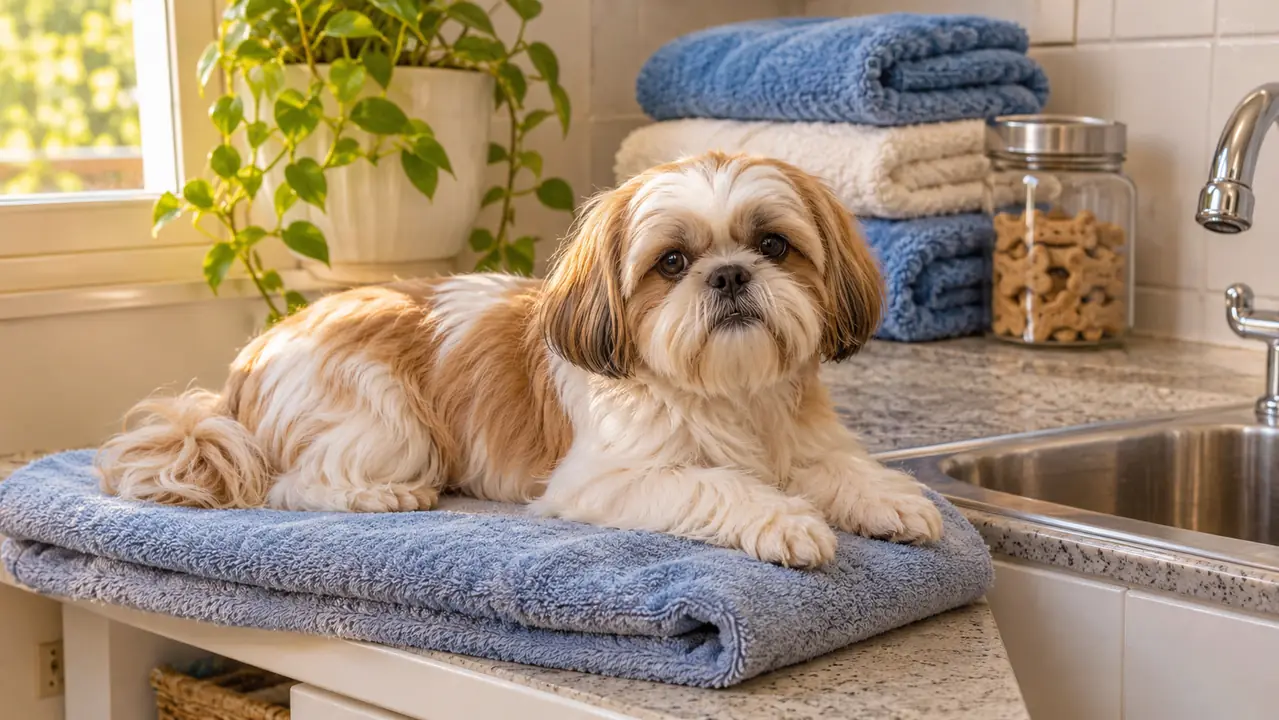
Step 4: Tap, Look, Tap Again, and Stay Well Away From the Quick
A dog's nail has a blood supply and a nerve running down the middle of it, called the quick. On a pale nail you can often see it as a pink shadow. On a dark nail you cannot see it at all, so you work in smaller increments and check more often. Either way the rule is the same: take a little, look, take a little, look.
I hold the paw steady with my left hand, tuck the nail into the port at roughly a 45 degree angle, and touch it for a second or two. Then I stop and look. Two or three touches takes the tip down. Then I turn the paw slightly and take the little hook off the underside of the nail. That underside pass is the one that stops the clicking on the tile, and it is the pass most people skip.
When you see a dark dot or a ring in the center of the flat end, you have gone far enough. On Mochi, whose nails grow fast, that is usually a little before the point where the nail starts to curve down toward the floor. I stop short of it on purpose. I would rather grind again in ten days than spend a Sunday night with a bleeding nail and a dog who no longer trusts me.
I learned that the hard way on a Tuesday in March, on the third nail of the left front paw. I had gotten comfortable, stopped looking between touches, and took one pass too many. There was a single bright bead of blood and a look on that dog's face I do not care to see again. Cornstarch, a firm minute of pressure, and a week off. She forgave me long before I stopped replaying it.
One nail a day for the first week. Mochi thought she was being paid to sit on a towel, which, as far as she knows, she was.
Step 5: Smooth the Edge, Pay the Dog, and Write It Down
The last pass is a smoothing one. Light pressure, one second per nail, just to knock off the rough edge the grinding leaves behind. It takes under a minute for all four paws and it is the difference between a nail that catches on the blanket and one that does not. It also means fewer snags on your own clothes when she climbs into your lap.
Then she gets the good treat. Not a piece of kibble, an actual piece of chicken, and she gets it on the towel so the laundry room stays a place where good things happen. I write the date on the wall calendar right there in the room. Mochi needs attention every two to three weeks, and a calendar on the wall is the only reason I remember for more than four days.
I also put a small check mark next to the entry if I only got through three of the four paws, because a half-finished job is easy to forget and very easy to notice two weeks later when one nail is twice as long as its neighbors.
If you do catch the quick, stay calm. Press a little styptic powder or plain cornstarch onto the end with your finger and hold it for a minute or two. It looks worse than it is. It also sets your training back, so give the dog a few easy days and then start again slower than you think you need to.
What Else Helps
Walking on pavement wears nails down, but it is not enough for most Shih Tzus. Mochi walks two short loops a day and mostly on grass, and her nails still grow. If your dog does serious sidewalk mileage you may get away with grinding every four weeks. If not, every two to three weeks is more realistic, and it is much easier on everyone than a big session every three months.
Tired dogs are easier dogs. I grind after the evening walk now, not before it, because a dog who has already spent her energy is much less interested in a wrestling match. A lick mat with a smear of peanut butter on it, stuck to the floor beside you, buys three or four quiet minutes. That is all the job takes once you are good at it.
Keep a towel on your lap and hold the paw from underneath rather than squeezing from the top. Most small dogs hate the squeeze far more than they hate the grinding. If the hair on the paw pads has grown long enough to cover the nails, trim that first so you can actually see what you are working on. You cannot grind what you cannot see, and Mochi's feet grow a small curtain of hair that hides everything.
One more check that costs nothing: stand across the room and listen while she walks on the tile. If you can hear clicking, you have another week or so of growth before anything needs doing, and you can pencil the session in for a night when you are not rushing dinner. If you hear nothing at all, leave the grinder in the drawer.
Twelve minutes, four paws, no fight in the laundry room
Two speeds, three grinding ports, and a cordless body that fits in one hand. Charge it the night before and keep the treats within reach.
Amazon Check Today's Price on Amazon →