
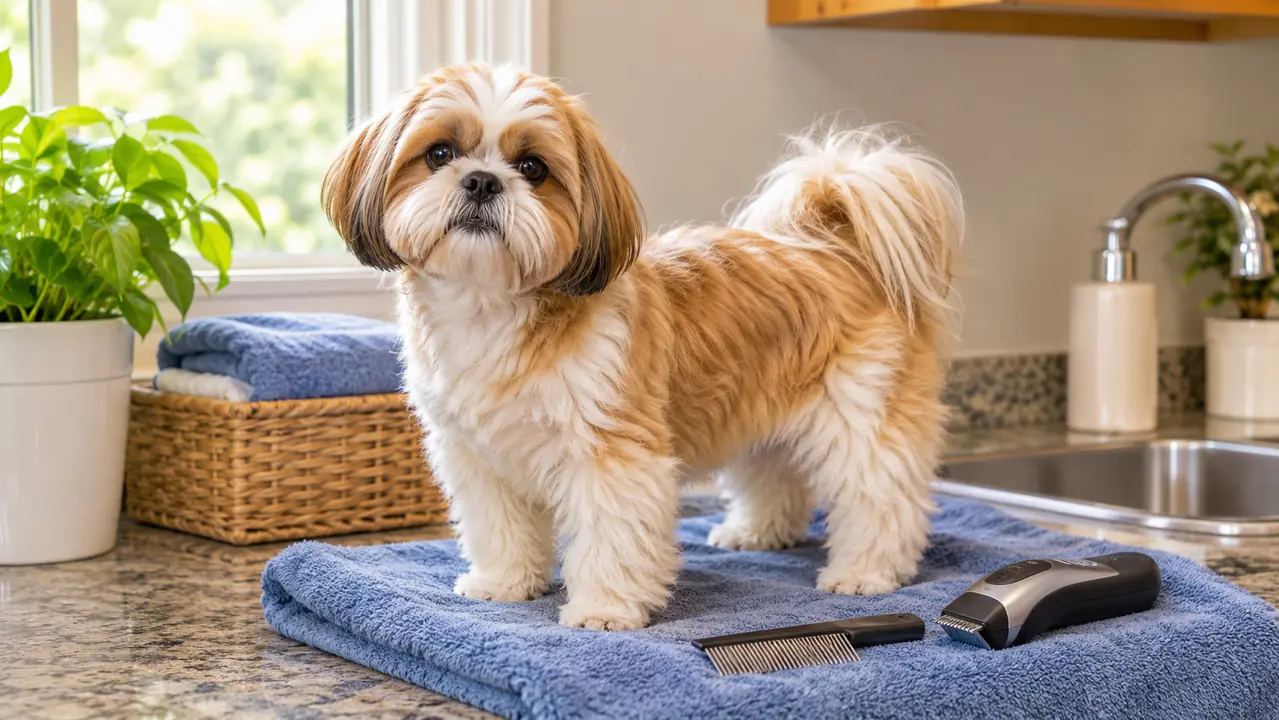
Mochi is seven years old, thirteen pounds, gold and white, and she has opinions. Her feet are off limits. Her ears are off limits when there is a mat behind them. For about three years my answer to all of that was to load her into the car every six weeks and let a groomer shave her down to a half inch of fuzz. She shook the whole way there and the whole way back, and she came home looking like a lamb that had lost an argument.
So I learned to do it myself. Badly at first. My first attempt involved kitchen shears, a bag of treats, and a back end that looked like it had been chewed on by a squirrel. What changed everything was the clipper. I use the oneisall low noise dog clippers, the cordless rechargeable kit my daughter brought over after watching me make a mess of Mochi's hindquarters. Two years on, I do a full puppy cut in the laundry room in about ninety minutes, and Mochi now falls asleep somewhere around the left rear leg.
One thing before we start. A puppy cut is a style, not an age. It means one length over the body, rounded and even, with the face and the topknot left longer. It is the most forgiving haircut a Shih Tzu can get, because there is nothing to blend. Go a little short on one flank and nobody sees it. In a week the coat grows into the mistake and it disappears. That is exactly why it is the right first haircut to try on your own dog, whether that dog is four months old or, like Mochi, seven.
A clipper quiet enough that my dog stopped fighting it
Mochi used to bolt at the sound of a groomer's clipper. The oneisall kit is rated below 50 dB, weighs about 13 ounces, and runs cordless off a rechargeable battery, with a charger that lets you keep clipping while it tops up. Six guide combs come in the box, from 3mm to 18mm, which covers every step below.
Amazon Check Today's Price on Amazon →Step 1: Set the Room Up Before You Touch the Dog
The cut starts about twenty minutes before the clipper does. Bath first, always. A dirty coat drags on the blade, cuts unevenly, and wears the cutting edge faster. I wash Mochi in the utility sink in the laundry room, towel her until she is damp rather than wet, and let her air dry the rest of the way while I set up. Clipping a damp coat gives you a choppy, stuck-together finish. Dry is the only way this works.
Then the mats. Run your fingers over the whole dog and find them before the clipper does, because a blade run straight into a tight mat will pull skin and scare the daylights out of everybody. Behind the ears and in the armpits are where Mochi gets hers. Work them apart with your fingers, then with the stainless comb, and if a mat will not come loose, scissor it out or take it down with a short comb before you do anything else. Never dig at a mat with the blade pressed in.
Last of the setup: a non-slip mat or a folded towel on the counter so the feet stay planted, light coming at the dog from two sides so you can see the coat lying flat, treats within reach, and the clipper charged with the charging cable plugged in nearby so you can run it while it charges if the battery gets low. Turn the clipper on and let it run on the counter for a few minutes while you brush her. By the time it touches her back, the sound is old news.
Step 2: Pick the Right Guide Comb and Seat It Flat
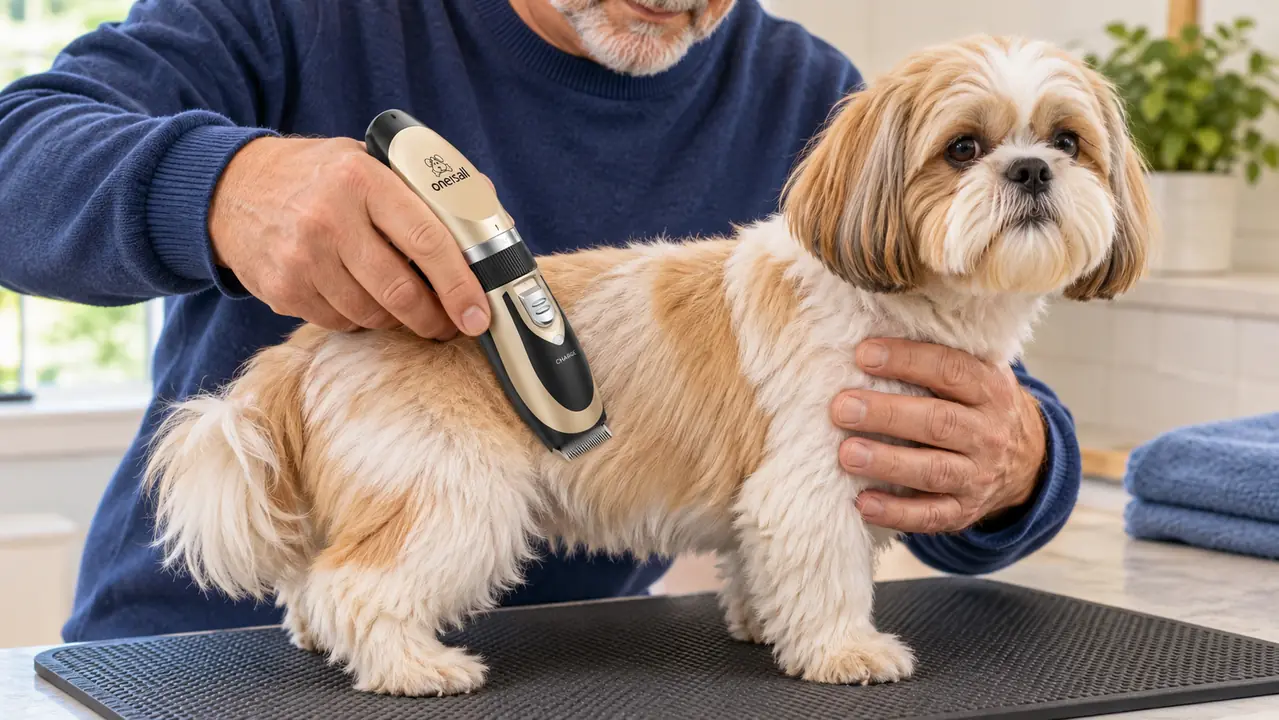
The oneisall kit comes with six guide combs: 3, 6, 9, 12, 15 and 18mm. For a medium puppy cut on a Shih Tzu, I run the 9mm over the body most of the year and switch to the 12mm in cold weather, when I want a little more coat left for warmth. The 15 and 18mm are for owners who prefer a fluffier finish or who are only tidying up between full cuts. The 3mm and 6mm cover feet, the sanitary area, and the face.
Snap the comb on until it seats flat against the blade, teeth pointing the direction you plan to clip, then give it a wiggle. A comb that is half on will cut at an angle and leave ridges you have to chase for the rest of the afternoon. Test it somewhere forgiving. I do one short pass on Mochi's shoulder before I commit to anything. The blade on this clipper is curved, which helps it follow the round of a ribcage instead of carving a flat trench, but only when you keep it lying flat against the skin rather than tipping it up on a corner.
If the coat is soft and puppy-fine, the comb will glide and you will be tempted to speed up. Do not. Fast passes bounce over the coat and skip spots, and you find every one of them in the final comb-through. Slow is faster here.
Step 3: Body First, With the Grain, in Overlapping Strokes
Clip in the direction the hair grows. On a Shih Tzu that means down the spine and down the flanks, from the neck toward the tail. Going against the grain cuts shorter and rougher, and it tugs at the roots. Keep the blade flat, use long slow strokes rather than short choppy ones, and overlap each pass by about half its width so you do not leave stripes down her side.
Your other hand is not decorative. Use it to hold the skin flat and slightly taut ahead of the blade. Loose skin on an older dog will fold into the blade if you let it, and the belly and the inside of the thighs are where that happens. Flat hand, flat blade, no pressing down. The clipper is light enough, about thirteen ounces, that you can let its own weight carry a long pass without your wrist aching halfway through the flank.
The order I use: back, then sides, then chest, then the belly last, because the belly is the part Mochi tolerates least and I want everything else finished before she runs out of patience. Cordless matters here more than you would expect. There is no cord dragging across the dog or wrapping a leg, so you can walk around the counter and change sides instead of reaching over her.

Step 4: Legs, Feet, and the Spots She Hates
Switch to the 3mm or 6mm comb for the legs and feet. I clip down the front of each leg with the lie of the hair, then around the outside of the paw with the paw held flat on the table, pads down, so the toes are spread and the skin is not bunched up. Do not lift the foot and clip at it from underneath. Flat and planted is safer, and it is calmer for a dog who does not want her feet handled in the first place.
The armpits are where the mats live, so go slowly and stay on a short comb. Skin there is thin and it folds. Same with the sanitary area at the rear. I use the 3mm, take small passes, and check the skin with my fingers after each one. If your dog will not hold still for that part, stop, put a treat on the counter, and come back to it tomorrow. There is no rule that says a haircut has to happen in one sitting. Mochi's first home cut took three days.
Ninety minutes, no car ride, no shaking, and a dog asleep on the third leg. That is what a quiet clipper actually gets you.
Step 5: Face, Topknot, Ears, and the Final Read
The face is the part to be careful with and the part people notice first. I use the 3mm comb along the cheeks, under the chin, and down the bridge of the nose, always moving the blade away from the eyes rather than toward them, with one hand gently under her jaw so she cannot turn into it. Around the eyes and the muzzle, scissors do the last of the work. Round the cheeks in a curve from the outside corner of the eye down to the jaw, and take small snips. You can always take more off. You cannot put it back.
Ears: clip the outside of the flap only. Never put a blade into the ear opening. The topknot stays long, so I trim it with scissors, holding it up between two fingers and cutting straight across the ends, then checking the length against her eyes so it clears them.
Then the final read. Run the stainless comb through the coat in every direction and feel for ridges, because your hands find what your eyes miss. Check the armpits, the back of the rear legs, and under the collar for patches you skipped. Look for any pink line or nick, especially on the belly and the inside of the thighs. Then let her go and watch her for a minute. If she does the shake-and-roll and trots off, you did fine. If she keeps licking one spot, go back and look at it.
What Else Helps
Short sessions beat long ones, especially the first few times. Twenty minutes and a break, then twenty more. Treats on the counter rather than on the floor, so she is not stretching down for them mid-clip. A second pair of hands for the feet and the sanitary area makes a real difference, even if that second pair belongs to a neighbor who is only there to hold one paw.
Keep the clipper in the room where the dog lives instead of buried in a drawer, and run it for a few seconds now and then when you are not clipping anything. A dog who has heard the sound a hundred times with nothing bad following it is a dog who stands still. And keep a professional groomer on the calendar two or three times a year anyway. I do. Somebody else's hands catch what mine have gotten used to, and a set of professional eyes on the ears and nails every few months is worth the trip.
If your Shih Tzu is an actual puppy, everything above still applies with the volume turned down. Puppy coat is soft and it clips easily, which is exactly when people get ambitious and take too much. Do the body in one pass, leave the face alone the first time, and let the puppy get used to the sound and the table. Ten good minutes is a win. Thirty bad ones set you back a month.
When to Put the Clippers Down and Call the Groomer
If the coat is one solid mat against the skin, do not try to save it. Severe matting pulls, hides sores, and needs to come off with a professional clipper and a groomer who can see what is underneath. The same goes for a dog who is snapping rather than wriggling. A groomer can finish in twenty minutes what would take you three anxious days, and there is no shame in that.
Stop for anything medical, too: red inflamed skin, a bad smell from an ear, a lump you have not felt before, or a cut that keeps bleeding after a few minutes of pressure. I am a retired nurse, not a veterinarian, and a clipper is not a diagnostic tool. Clip the dog, love the dog, and hand the medical questions to somebody with a license.
The kit that turned a wrestling match into a ninety minute routine
oneisall low noise dog clippers: cordless, rechargeable, below 50 dB, six guide combs from 3mm to 18mm, a stainless steel comb and charging cable in the box, and a two-year manufacturer warranty behind it. It is the clipper I have used for every home cut on Mochi for two years.
Amazon Check Today's Price on Amazon →