
The first mat I found on Mochi was behind her left ear, about the size of a pencil eraser, and I handled it as badly as a person can. I got a brush, I held her by the collar, and I pulled. She made a sound I had never heard her make. The mat did not come out. It got tighter, and she spent the rest of the afternoon under the dining table giving me looks. That was the day I learned that a mat behind the ear is where getting away with home grooming stops.
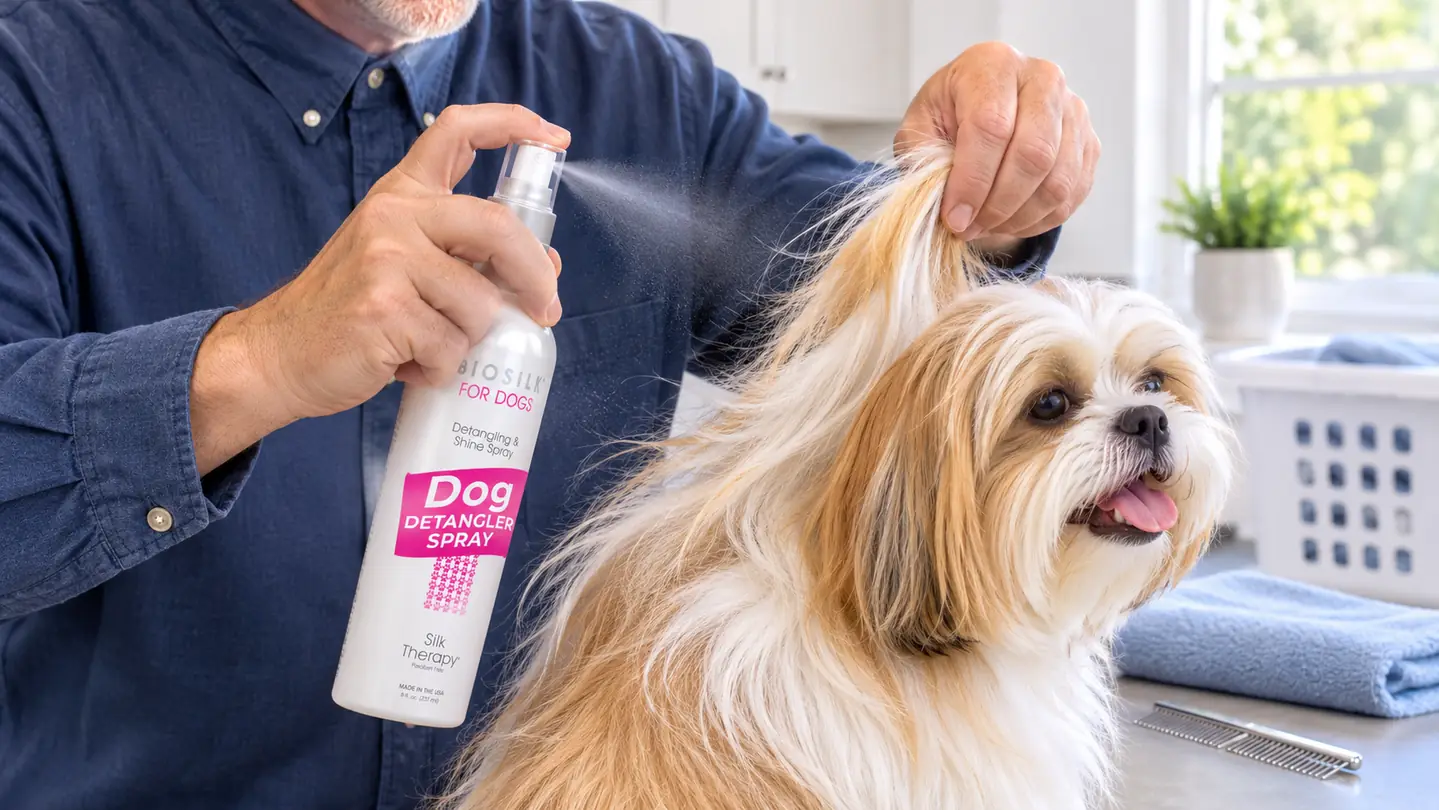
What I tried next was everything except the right thing. Human conditioner. Coconut oil from the kitchen. A pair of small scissors I am not proud of. What finally worked was duller and slower than all of it. A detangler made for dogs, applied before I touched the knot, and then a comb used from the ends backward. The spray that lives on the shelf in my laundry room now is BioSilk Silk Therapy Dog Detangler, the 8 fl oz bottle. I will not pretend it is magic. It does one job, which is to make the coat slippery enough that the hairs let go of each other instead of fighting you. That is the whole idea, and it is enough.
Start with the spray, not the brush
BioSilk Silk Therapy Dog Detangler, 8 fl oz. Silk proteins coat the hair shaft so the knot loosens before the comb ever gets there. It is the first tool I reach for and the last one I would give up.
Amazon Check Today's Price on Amazon →Step 1: Set up before the dog knows anything is happening
Mochi is seven, thirteen pounds, and she can read my posture from across the room. If I stand up with a purpose, she is already under the bed. So the setup matters as much as the technique, at least at my house. I pick a time when she is already tired, usually twenty minutes after a walk, and I work in the laundry room where the light is good and the floor is not slick. I lay a towel down first, because a dog on a smooth floor will scramble, and a dog who scrambles remembers grooming as a fight.
Everything I need is within arm's reach before I touch her. The spray bottle, a metal comb, two treats torn into small pieces, a second towel. If I have to stand up and hunt for something mid-mat, I lose her. I sit on the floor with my back against the cabinet and let her settle against my leg. I do not clip her to anything and I do not hold her down. I keep one flat hand on her shoulder the whole time, mostly so she knows where I am. If she gets up, she gets up, and we try again in ten minutes. That sounds soft. It is also the reason I can get a comb through her armpits at sixty-two without a muzzle.
Step 2: Read the knot before you touch it
There is a difference between a tangle and a mat, and it decides how the next twenty minutes go. A tangle is hair crossed over itself. You can see through it and the skin underneath is easy to find. A mat is felt. The hairs have locked and the whole thing has drawn up toward the skin, and if you pull on it, the skin comes with it. Mochi gets tangles in her topknot and mats behind her ears, in her armpits, and along the collar line where the harness rubs.
So I part the coat down to the skin with my fingers before I pick up any tool. If I can slide two fingers between the mat and the skin, it is a home job. If I cannot, or if the skin underneath is red, feels warm, or smells like yeast, I stop and it goes to the groomer. I say that as someone who hates paying for it. A mat that has already been through a bath gets the same answer. Water tightens felt the way it tightens a wool sweater, and a matted coat that gets wet and then dries is twice the job it was before.
The last thing I check is her mood. If her ears are back and she is licking her lips before I have started, I have about two minutes of patience to work with, and I should spend it on the smallest mat, not the worst one. A dog who has one good experience will let you come back tomorrow. A dog who has one bad one will not.
Step 3: Spritz the mat and give it a minute
This is the step people skip, and it is the only one that changes the physics. I spray the mat itself, not the whole dog. The point is to get the coat damp at the knot, not to give her a bath. BioSilk goes on as a fine mist, and the silk proteins in it coat the hair shaft so the fibers slide past each other instead of grabbing. That is the listing's own description and it matches what my hands feel, because the hair goes from grippy to slick in about a minute.
Then I wait. I set the bottle down and rub the mat between my thumb and forefinger, gently, working the spray into the middle of it instead of across the surface. Thirty seconds to a minute, that is all. It feels like doing nothing. It is the most useful minute in the entire process. What I no longer do is soak her. A wet coat takes an hour to dry in a Fort Worth summer and most of a day in January, and damp hair behind the ears is how you end up with a skin problem stacked on top of a mat problem.
Two practical notes. The bottle is labeled unscented and I would call it close to that. There is a clean smell for a few minutes that fades as the coat dries, which matters because Mochi sleeps against my face. And the formula is pH balanced for canine skin rather than human skin. I used my own leave-in conditioner for years and I stopped, because dog skin is not people skin, and something built for my scalp has no business sitting on her coat for a week.

Step 4: Break the mat apart with your fingers, then comb from the ends up
Fingers first. Not a brush, not a comb, not a mat splitter. I pinch the mat between both thumbs and forefingers and pull it apart sideways, in layers, close to the skin, the way you would separate a felted sweater. Sideways is the whole idea. Hair pulled away from the skin tears and hurts. Hair pulled apart along the skin has somewhere to go.
Once the mat is broken into smaller pieces, I switch to a metal comb with two tooth lengths, the kind groomers call a greyhound comb. I start at the tip of the hair, not at the skin. Short strokes, an inch at a time, working up toward the skin as the comb starts to move freely. My free hand holds the coat at the base, between the comb and the skin, so if the comb catches, it catches against my fingers instead of against her. Same comb, same dog, a fraction of the drama. This is the technique that changed grooming in this house.
I do one section at a time and I finish a section before I move on. Behind the left ear, then the right, then the armpits, then the collar line. If the comb stops, that spot gets another spritz of BioSilk and another minute. It does not get more force. When the comb passes through clean from skin to tip with no catch, that section is done and I say so out loud. Mochi does not speak English. She does know the word done.
Step 5: Dry, check again, and set a stopping rule
I blot the damp spots with a towel and let the rest air dry. No hair dryer. A dryer on a coat that still has a tangle in it is a fine way to bake the tangle in, and Mochi hates the noise anyway. Once she is dry, I run the comb through the sections I worked on one more time. Dry hair behaves differently than damp hair, and a spot that felt clean when it was wet will tell on itself now.
Here is my stopping rule, and I wish someone had handed it to me years ago. Ten minutes per mat. If it is not out in ten, I stop, I put a treat in front of her, and I call the groomer. Not because I failed, but because a mat that will not budge in ten minutes with spray and a comb is felted to the skin, and the right tool at that point is a clipper blade. The second rule is one session a day. Mats that took a month to form do not have to come out in one sitting. Two short sessions beat one long one that ends with both of us upset.
What Else Helps
Detangling is the emergency. Maintenance is what keeps you out of the emergency. In this house that means a five-minute comb-through three times a week, with a light mist of BioSilk on the armpits and behind the ears before the comb touches her. A bath every three or four weeks, and the coat combed out completely before the bath, never after. A word to the groomer to keep the ears and the armpits short between visits, since that is where Mochi mats no matter what I do. A slicker brush is fine for the surface of the coat. The comb is what tells you the truth.
What has not helped, in case you were wondering. Coconut oil does loosen a knot, but it stays greasy, and grease collects lint and dust until the coat looks worse than the mat did. Human conditioner left her coat flat and slightly tacky for days. And pulling, obviously. Pulling is the thing that taught a thirteen-pound dog to hide under the bed when I stand up. The right order is spray, wait, separate with your fingers, comb from the ends. Boring, slow, and it works.
Ten minutes of pulling did nothing except teach her to hide. Two minutes of spray and a comb started at the ends took the mat out with her still sitting on the towel.
The bottle that makes the comb slide instead of snag
8 fl oz of BioSilk Silk Therapy Dog Detangler, pH balanced for canine skin, with silk proteins that coat the hair shaft so a mat lets go before your dog decides she has had enough.
Amazon Check Today's Price on Amazon →